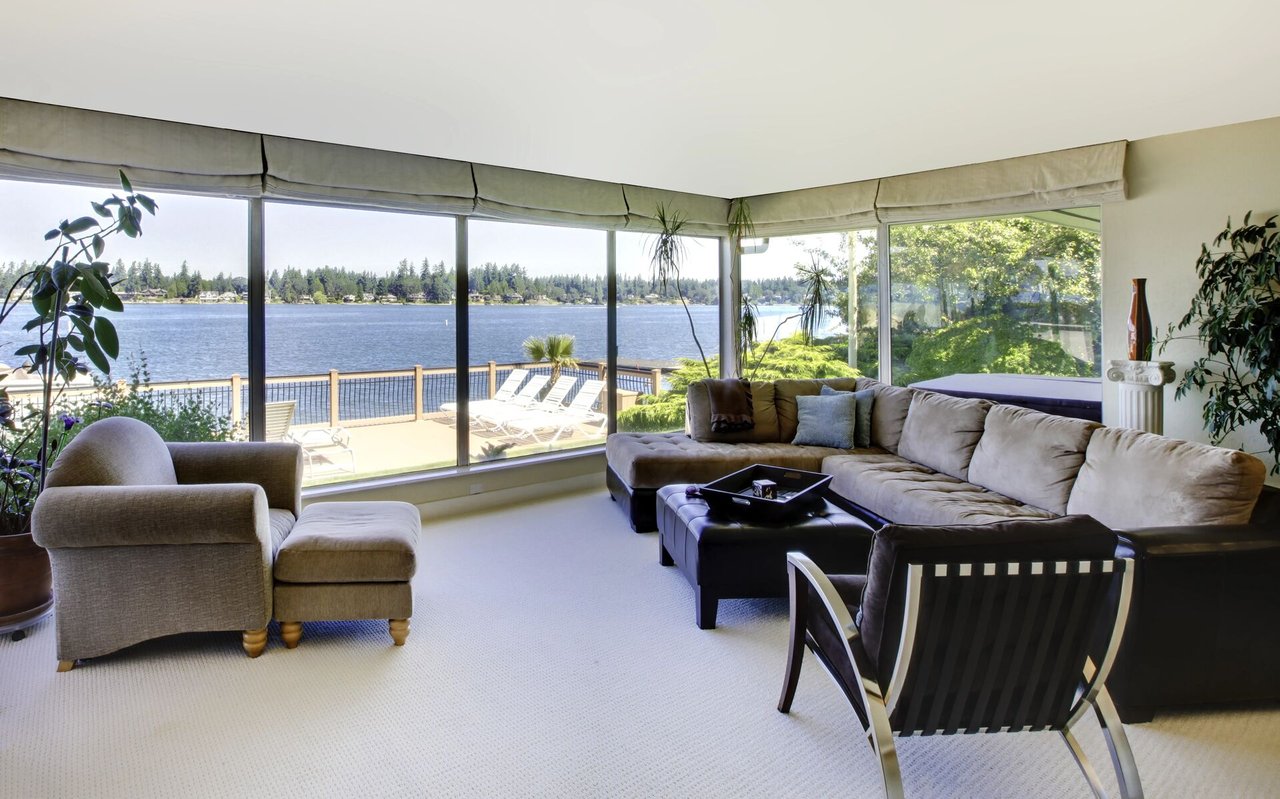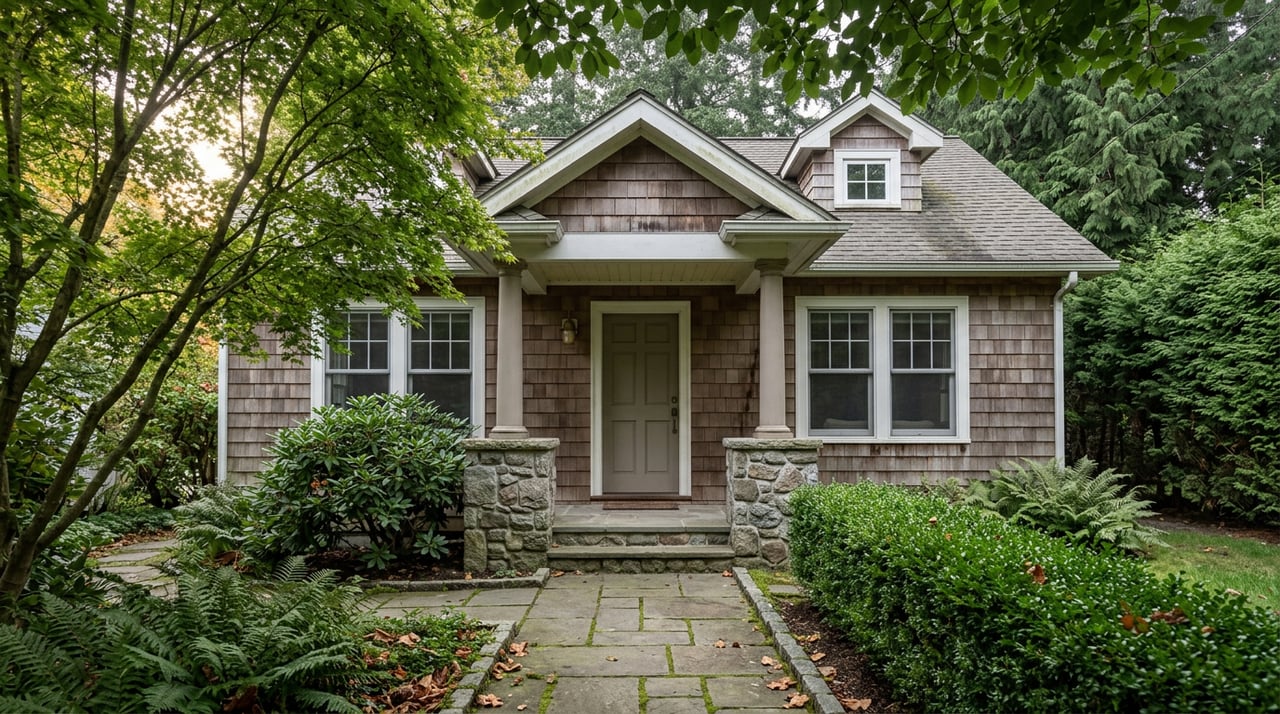
On closing day in most Eastside neighborhoods, a buyer signs a deed, records it with King County, and gets the keys. In Beaux Arts Village, that same signature enrolls the buyer in something else: membership in the Western Academy of Beaux Arts, the 118-year-old organization that has owned and governed the town's private lakefront since 1908. Nobody applies. Nobody pays dues to join. Home ownership and Academy membership arrive as a single package, and the buyer typically finds out how that works only after their agent explains it, or after they've already signed.
That is the first thing worth knowing before writing an offer here. The second, and the one that actually explains what buyers see on the price sheet, is buried in a planning document most people never open: the town's own 2025-2045 Comprehensive Plan, adopted by the Town Council on December 30, 2024. Under the growth allocation King County assigned as part of that plan, Beaux Arts Village is required to accommodate exactly one additional housing unit between now and 2044. Not one per year. One, total, over the next two decades.
That number is the mechanism behind everything else in this market.
Two governments, one deed
Beaux Arts Village runs on a split structure that has nothing to do with typical HOA arrangements. The elected Town Council, a mayor and five unpaid council members serving staggered four-year terms, handles municipal business: most roads, the town's water system, and contracts for police and fire protection. The town has no police department of its own and no fire department either. Law enforcement runs through a contract with the King County Sheriff's Office, and fire response comes from the City of Bellevue.
Running alongside the Town Council, and governing a different set of assets entirely, is the Western Academy of Beaux Arts. WABA owns the 1,100 feet of Lake Washington shoreline that gives the town its identity, along with the beach roads, docks, and floats. Every property owner in town is automatically a WABA member and elects five trustees each year to manage the beach. The town government and the beach government don't overlap on paper, but in practice a buyer here is opting into both the moment they close.
There isn't even a town hall. Council and Planning Commission meetings rotate through members' living rooms, open to the public, a detail confirmed on the town's own website. Two part-time clerks run day-to-day operations from home offices. This isn't quaint dressing on a listing description. It's the actual administrative reality a buyer is joining, and it shapes how slowly anything here changes, including the housing stock itself.
The number the county wrote down
Washington's Growth Management Act requires cities and counties to periodically update their comprehensive plans and forecast how much new housing they need to accommodate over a twenty-year horizon, a requirement spelled out in RCW 36.70A.130. King County allocates a share of the region's projected growth to every city and town inside its urban growth area, including Beaux Arts Village.
The county's allocation for Beaux Arts Village, documented in the town's adopted Comprehensive Plan, is one additional housing unit through 2044. The plan itself describes the town's built environment plainly: a mature residential area of moderately sized single-family homes on generous lots, already built out, with housing availability functioning almost entirely on resale rather than new construction. There is no meaningful undeveloped land left to subdivide, and the zoning code, which the Planning Commission reviews alongside the Comprehensive Plan, keeps it that way by design.
That planning reality tracks the town's origin story. Beaux Arts Village started in 1909 as an arts colony on fifty acres purchased by Academy founder Frank Calvert, who deeded the shoreline itself to the Academy to keep it out of public hands. When the town formally incorporated in 1954, it did so specifically to avoid being annexed by an expanding Bellevue, according to HistoryLink's history of the town. Every structural choice since, incorporation, the WABA/beach split, the current zoning, has pointed toward staying exactly this size. The one-unit growth target isn't a fluke of a formula. It's the logical endpoint of a hundred years of the town choosing not to grow.
What zero growth does to a resale market
A neighborhood that can add, at most, a single housing unit over twenty years doesn't behave like a normal resale market, because the normal release valve, new construction responding to demand, doesn't exist. Every transaction here is a resale, and the Comprehensive Plan's own housing data (drawn from 2022 American Community Survey estimates) puts owner-occupancy in the town at roughly 93 percent. Almost nobody rents, and almost nobody in that 93 percent has a reason to sell into a market where buying back in later is close to impossible.
The pricing data reflects that. As of the most recent period reported through county MLS data, in mid-2025, the median sale price for a home in the town itself was $2.6 million, up roughly 26 percent from the year before. In the broader Enatai and Beaux Arts Village corridor that brokerages track together, given how few sales close inside the town's tenth-of-a-square-mile footprint in any given year, the average sale price over a recent trailing twelve months ran just over $3.3 million, up about 12 percent year over year, with homes going under contract in roughly a month, well ahead of the national average.
None of those numbers describe a market correcting toward equilibrium. They describe a market where the supply curve is fixed by county allocation, not by builders responding to price signals, which is the actual explanation for why appreciation here doesn't behave like appreciation in a neighborhood where a developer could, in theory, add twenty townhomes next year.
What buyers actually get, and what they don't
The town's own artesian well supplies its water, untreated with chlorine and without added fluoride, tested periodically per Washington State Department of Health requirements, a detail worth flagging to a pediatrician or dentist rather than assuming it matches typical municipal water. Sewer service comes through the City of Bellevue under a franchise agreement, not the town itself.
The private beach WABA governs sits within walking distance of two public alternatives that don't require Academy membership: Enatai Beach Park, with its swimming area, boathouse, and seasonal kayak and canoe rentals, and Mercer Slough Nature Park a few minutes away, with guided canoe tours and walking trails. Buyers weighing Beaux Arts Village against nearby Enatai or other West Bellevue waterfront should know the private beach is a real amenity, but it isn't the only lake access in the immediate area, and it comes bundled with governance obligations, beach cleanup duties, trustee elections, that a straightforward Bellevue waterfront purchase wouldn't carry.
Students in the town attend Bellevue School District schools, Enatai Elementary, Chinook Middle School, and Bellevue High School, the same district serving much of West Bellevue.
What this means if you're comparing neighborhoods
A buyer who treats the online median as a data point to negotiate against is missing the actual constraint. There is effectively no supply-side response available in this market, now or for the next two decades, and the town's founding structure was built specifically to keep it that way. That changes how a serious offer should be built, how patient a buyer needs to be waiting for the right listing, and how carefully a purchase agreement should address WABA membership transfer, beach assessment obligations, and the town's water system disclosures before anyone signs.
If Beaux Arts Village is on your list alongside Medina, Enatai, or Mercer Island waterfront, the comparison isn't really about square footage or lot size. It's about which of those markets can theoretically add inventory and which one, by county allocation, essentially cannot.
Diane Tien works this exact intersection of Eastside waterfront markets daily, from the private, closely held listings in towns like Beaux Arts Village to the broader Medina and Mercer Island shoreline. If you're weighing a purchase here against another Eastside waterfront option, schedule a strategic consultation before you write an offer, not after.
Frequently asked questions
Is Beaux Arts Village part of Bellevue? No. It is a separate incorporated town, surrounded on three sides by the City of Bellevue and bordered on the west by Lake Washington, with its own elected Town Council.
Does every home come with beach access? Every property owner in the town is automatically a member of the Western Academy of Beaux Arts, which governs the private beach, docks, and floats. Access runs with ownership rather than with a specific lot's proximity to the water.
What happens to WABA membership when a home sells? Membership is tied to ownership of property within the town, so it transfers to the new owner at closing rather than staying with the seller or requiring a separate application.